
“James — plate, sink. Now.”
Monica’s voice carried the kind of authority only a long-suffering mother could summon: equal parts command, prayer, and thinly veiled threat.
Four-year-old James had inhaled his dinner at warp speed, eager to return to whatever Lego-based crisis was unfolding in the next room.
On the floor, baby Tara giggled as she conducted her ongoing science experiment in gravity. Mashed peas, zero. Hardwood floor, one. Monica took small comfort in knowing she’d mopped earlier—a brief, shining victory in her never-ending war against entropy.
Then came the inevitable shout from the living room.
“I did put it in the sink!”
Of course he hadn’t. Probably.
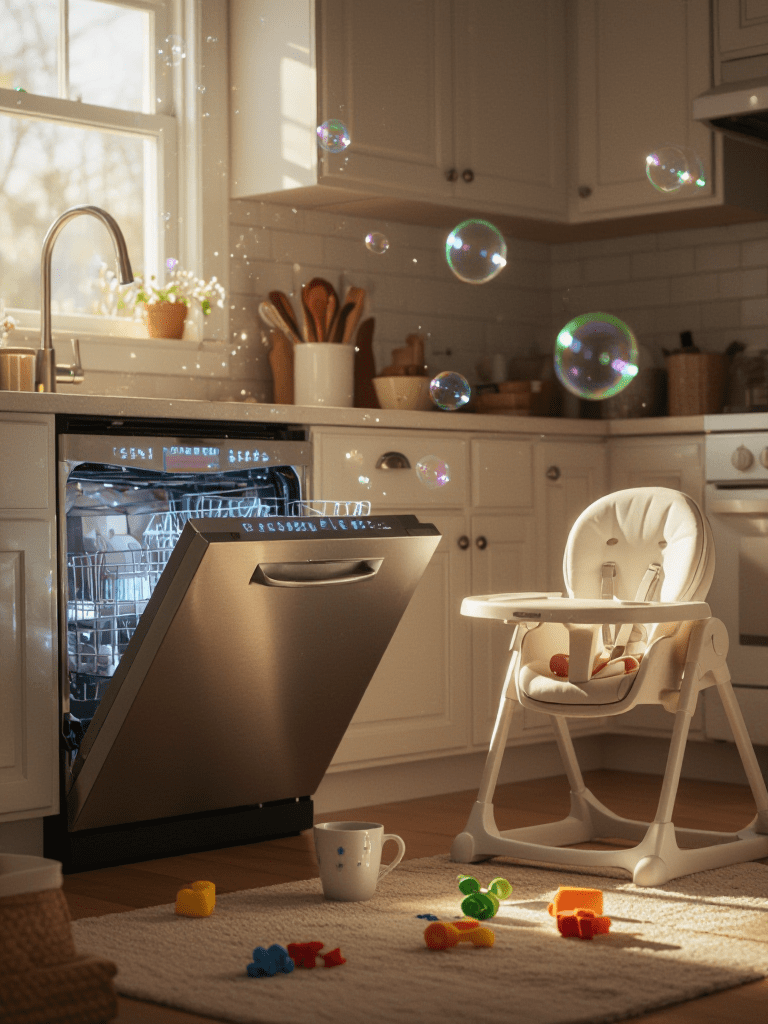
Still, when she peeked in, there it was—a plate actually in the sink. Progress. Encouraged, Monica raced the clock of domestic disaster: wiping down the highchair, scrubbing the table, then turning to face her next opponent—the dishwasher.
Adam’s “smart dishwasher,” as he liked to call it, was smart the way toddlers were honest: unpredictably and with questionable motives. Ever since her husband—part-time IT guy, full-time wizard—had enchanted it to “self-optimize,” the thing had developed what could only be described as a personality. Moody. Dramatic. Loudly opinionated.
She rinsed a plate and addressed the machine as though negotiating a hostage release.
“Come on, open up. The kids are probably inventing new ways to cause property damage.”
The dishwasher emitted a low growl that could only be described as mechanical sulking.
“Don’t start,” she muttered. “I do not have the energy for attitude today.”
The latch finally clicked, and the door lowered with theatrical slowness. Monica rolled her eyes.
“You know, R2-D2 is less whiny than you.”
Inside, the racks creaked out like a sigh. It wasn’t that she minded Adam’s magical tinkering. His “improvements” just came with quirks. The coffee maker still hummed lullabies to itself after brewing. The toaster occasionally threw bread across the room like it was in training for the shot put. And the dishwasher—well, the dishwasher seemed to take personal offense at being asked to do dishes.
Still, it cleaned better than any mortal appliance she’d ever owned. She loaded it quickly, because in this house, peace never lasted long.
Sure enough, just as she shut the door, something outside the window caught her eye. A bluebird perched on the frost-silvered branch of the tree beyond the glass, pecking at bright red berries. The light caught the scene perfectly—like a living snow globe.
For the first time that morning, she exhaled. The chaos behind her blurred into white noise.
Then she ruined her own peace by calling out, “Hey, Sophie! Wanna see Brightbill?”
Tiny feet thundered down the hall. Sophie, age three and fully powered by joy, came skidding into the kitchen like an action hero mid-slide.
“Where? Where’s Brightbill?”
Monica smiled and pointed toward the window. Sophie dragged her little step stool over, climbed up, and pressed her nose against the glass. The bird was still there, utterly unbothered.
“Brightbill!” she shrieked. “He’s back!”
Monica couldn’t help but laugh. Ever since Sophie had watched The Wild Robot, every bird had been “Brightbill.” The name had stuck to sparrows, robins, and once, a particularly confused flamingo on TV. Monica didn’t mind—it gave her something to look forward to in the chaos.
But then the air shifted. A faint tingle, like cinnamon and static, rippled through the room. The smell of ozone followed.
Monica froze. That was magic.
Her husband’s spellwork always left that faint shimmer in the air, but this didn’t feel like him. This was new—and unsettling. She turned toward Sophie. The little girl was practically vibrating with excitement.
“Sweetheart…” Monica began, but the words died in her throat.
Clark, their familiar—a sleek orange tabby with the personality of a retired professor—strolled into the kitchen, tail flicking.
“What is going on in here? It smells like panic and amateur magic. Which, I suppose, is our brand.”
Monica pinched the bridge of her nose. “Don’t start. I just need to figure out—”
Before she could finish, a flutter of movement caught her attention. A bird had landed on the windowsill beside the bluebird. Then another. And another. Within seconds, the branches outside were covered—sparrows, crows, finches, pigeons. Then more came. Dozens. Hundreds. It was like the sky itself had decided to roost in her backyard.
Clark hopped onto the counter, his golden eyes wide.
“Well. That escalated quickly.”
“You think?” Monica snapped, staring in disbelief.
Clark peered closer. “You’ve got at least three endangered species out there and one goose that looks like it wants a fight.”
Sophie squealed with delight. “Brightbill brought friends!”
Clark sighed. “I told you we should’ve gotten a goldfish. Fewer feathers. Less drama.”
Monica ignored him. “Okay, Clark, ideas? Anything? You’re magical. Make them leave.”
“I specialize in household spells, not mass avian relocation,” he said dryly. “I can make the sink self-drain or the broom sweep itself, but I don’t have ‘bird-be-gone’ in my repertoire.”
She groaned. “Perfect. What about scaring them?”
“With what, my charm?” he asked. “It’s been known to work, but usually not on wildlife.”
She glared at him. “You know what? I have an idea. It’s stupid, but it’s all I’ve got.”
She grabbed him by the scruff and headed for the back door. “Wait—Monica! I do not consent to—” he began, but it was too late. She threw the door open and tossed him outside.
Her reasoning, in its entirety, was this: cats eat birds. Birds fear cats. Problem solved.
Except, of course, it wasn’t.
Monica ran to the window, where James and Sophie pressed their faces to the glass. Outside, Clark sat in the snow, looking personally betrayed. His fur bristled. His tail flicked. The birds were entirely unimpressed.
Clark looked up. “May I come back inside now?”
“No! You’re supposed to be scary. Try to be fearsome!”
A small sparrow hopped closer and chirped something sassy. Clark turned to Monica.
“They say they’re more afraid of humans. Why don’t you come out here and be fearsome?”
She blinked. “Right. Talking cat. Forgot that part.”
“Since you’re chatting anyway,” she called, “ask them why they’re here!”
Clark muttered something under his breath, then engaged in what looked like an intense debate with the sparrow. After a few moments, he turned back toward the house.
“They said they’ll leave after they’ve shown the one who summoned them their performance. A flight demonstration, apparently.”
That didn’t sound threatening—just weirdly polite. Monica sighed. “Fine. Let’s go see the show.”
Five chaotic minutes later, coats were zipped, boots were on, and they stepped into the yard. Hundreds of birds watched them in eerie unison. Monica felt like she was standing in the world’s fluffiest tribunal.
The kids didn’t notice. They barreled forward into the middle of the yard, laughing. The birds parted gracefully to let them through, not one feather ruffled.
Then, without warning, the flock lifted as one.
The air filled with the roar of wings. Feathers and snow swirled together as the birds rose, spinning higher and higher until they formed a shimmering funnel of motion—like a tornado made of rainbows and wind.
But there was no danger. Just beauty.
The children shrieked with laughter. The birds danced above them—swooping, spiraling, weaving intricate shapes in the sky. It was so precise, so full of wonder, it almost seemed rehearsed. The magic hung in the air like sunlight.
When it ended, the birds broke formation. One by one, they drifted away until only the kids and Clark remained in the snow.
“Anyone going to tell me what all the birds were about?” said a familiar voice behind them.
Adam stood in the driveway, laptop bag slung over his shoulder, eyebrows raised. “Because it did not make parking easy.”
Monica turned, deadpan. “Maybe your dishwasher summoned them. It’s been moody all day.”
Adam blinked, then groaned. “You didn’t… talk back to it again, did you?”
“Define talk back.”
Clark smirked. “Define again.”


 Witch, Please
Leave a comment